Authenticity Is a Licensing Requirement, Not a Marketing Nice-to-Have

Updated: Aug 28
In my last post, I wrote about what a licensing partner actually checks before committing to a deal: content pipeline, retail interest, decision-making authority, and category sequencing. All of it commercial. None of it is creative. A brand can clear every one of those checks and still stall at the table, for a reason most brand owners never see coming.
The brand looks strong on paper. The pitch is solid. The numbers hold up. And somewhere in the room, the deal quietly loses momentum, because something about the brand doesn't hold together once someone tries to picture it living in a different market.
That is authenticity, and it belongs on the checklist next to everything else I look at.
Brand Authenticity isn't a values statement
The word "brand authenticity" gets used loosely in marketing, usually to mean something close to sincerity. That is not what a licensing partner is evaluating. What they are actually checking is cultural coherence: whether the brand's identity makes sense on its own terms once it leaves the market it was built in or whether it only worked because everyone in the room already shared the same references.
Licensing depends on something more specific than a good story. It depends on what I've come to think of as design language: not just the logo, the colors, or the layout, but the rhythm, hierarchy, narrative logic, emotional tone, and behavioral expectations that make a brand cohere. A partner isn't only licensing your assets. They're licensing your design language, and if that language doesn't survive the trip, the assets arrive looking correct while feeling empty.
Where it shows up in the room
A partner reads authenticity risk in a handful of concrete signals. A brand story that only makes sense with cultural context the new audience doesn't have.
A visual identity that was never tested outside the home market and depends on color, symbol, or composition choices that carry different meaning elsewhere. Humor or tone built on assumptions the new audience simply doesn't hold. Even pacing and rhythm, in a show or a campaign, can carry cultural assumptions a brand owner never had reason to question.
One of the sharpest formulations of this comes from a senior licensing executive based in Singapore, who put it plainly: licensing only works when the design language is kept intact. Partners aren't asking brand owners to hand over a rulebook. They're asking whether the underlying grammar of the brand, the logic that explains why an element works and not just what it looks like, can travel with the assets. When that grammar gets lost, partners default to literal replication: copying the visuals precisely while missing what made them meaningful. The execution looks compliant and feels disconnected, and it often gets misdiagnosed as brand misuse rather than what it actually is, a failure of translation.
This is also where category sequencing, something I wrote about in my last post, connects directly to authenticity. The right first category in a new market is often the one where the brand's core identity translates most cleanly, not the one with the highest ceiling. A partner evaluating a first launch is really asking whether this version of the brand, in this category, will read as coherent to a new audience. Get that sequencing wrong and even a culturally sound brand can look shaky in its first outing.
Two examples worth sitting with
Panda Express is not a licensing case, but it is one of the clearest illustrations of what translation actually looks like when it works. As one licensing executive in China put it: Panda Express is not Chinese, but Americans love it. The brand never claimed to represent regional Chinese cuisine. It positioned itself openly as American Chinese food, translated portioning, flavor, and service speed into U.S. fast-food conventions, and let trust build around what it consistently delivered rather than what it symbolically claimed. That is hybrid authenticity done honestly: state the frame, then deliver coherence inside it.
Ski Dubai runs the opposite play and still lands. An indoor ski slope inside a desert mall is a visible cultural contradiction, and it never pretends otherwise. It works because the contrast is framed as intentional rather than concealed, and because it is embedded inside an existing routine, Mall of the Emirates draws more than 40 million visitors a year, so participation doesn't require anyone to learn a new cultural script.
Both cases point to the same underlying rule: authenticity does not require sameness with the origin. It requires that whatever gets built, faithful or deliberately contrasting, be coherent enough to be trusted and repeatable enough to be lived in.
Why brand owners miss this from the inside
This is the same blind spot I wrote about in the readiness post: every signal from inside a strong home market is positive, so there's no obvious reason to question anything. A brand dominating its category domestically gets no early warning that its story, its visuals, or its tone were built for one audience and one audience only.
Success at home doesn't just fail to predict success abroad. It actively hides the questions a brand owner should be asking.
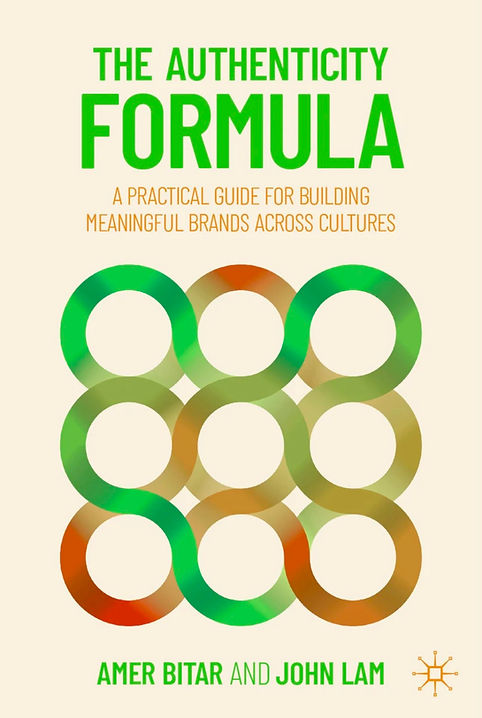
This is the gap I mapped in The Authenticity Formula. Together with my co-author John Lam, we spent time with more than sixty entrepreneurs, marketers, and cultural authorities to understand how brand identity actually survives, or doesn't, when it moves across cultures. Space, aesthetics, pop culture, and storytelling kept surfacing as the four places where a brand either translates or quietly falls apart, and licensing sits directly inside that fourth category.
A license is, structurally, a story asking to be retold by someone else, in a market the brand didn't build for.
What to Check Before You Sit Down With a Partner
A few questions are worth answering honestly before that conversation happens, not during it.
Has anyone outside the home market actually reacted to this brand?
Has every reaction so far come from people who already understand it?
Does the story survive a plain retelling, stripped of the cultural shorthand a local audience fills in automatically?
Would the visual identity still read correctly if the logo were removed, or does it depend on context the new market won't supply?
Has the brand been shown to someone from the target market before the deal was already in motion, or is that feedback happening for the first time at the negotiating table?
A brand owner who can answer these with evidence, not confidence, walks into a licensing conversation in a fundamentally different position than one discovering the answers in real time, in front of a partner who has seen this gap before.
Authenticity, in the end, is the thing that lets a deal survive contact with a new market. It comes before the numbers, before the pipeline, and before any of the commercial checks I wrote about last time, because none of those checks matter if the brand doesn't hold together once it arrives.


Comments